

MiniSplitsforLess Sets Out a Guide to Choosing and Sizing a Ductless Mini Split

Illustration: a bedroom measured before choosing the size of a ductless mini split.
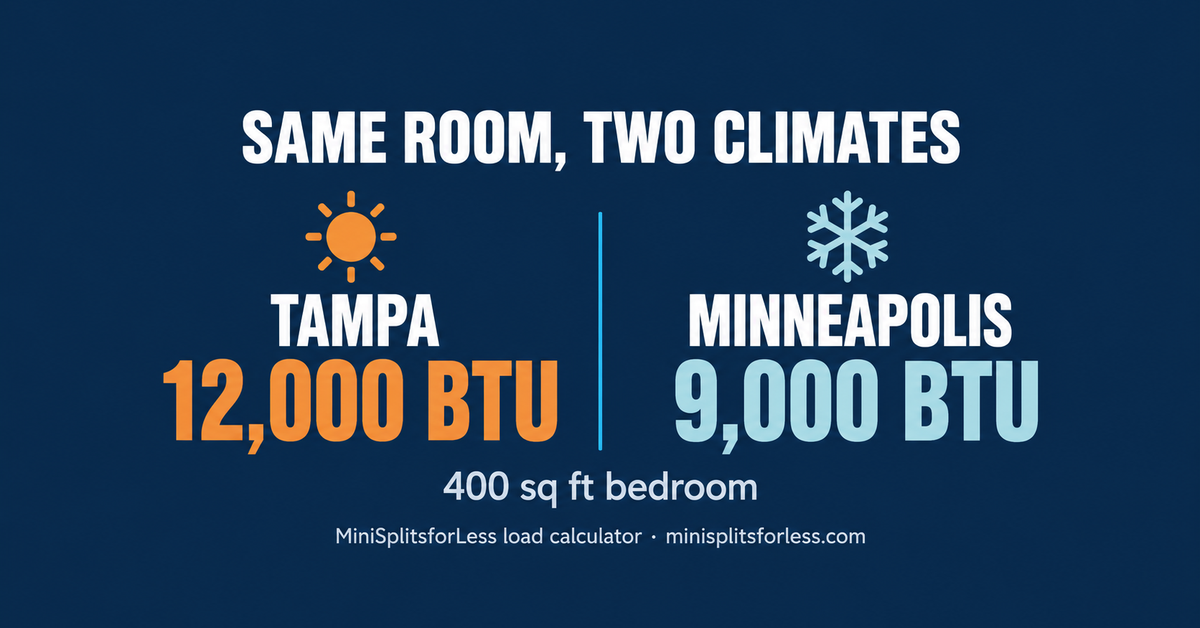
Illustration: the MiniSplitsforLess load calculator sizes the same 400 sq ft bedroom differently in Tampa and Minneapolis.

Illustration: MiniSplitsforLess ships from warehouses in California, Texas and Florida.
The MiniSplitsforLess guide sizes rooms from 26 BTU per square foot in its load calculator and maps delivery from warehouses in Florida, Texas and California
MIAMI, FL, UNITED STATES, October 31, 2026 /EINPresswire.com/ -- MiniSplitsforLess, a Miami-based online retailer of ductless mini split systems that has shipped nationwide since 2019, today set out a guide to choosing and sizing a ductless mini split, built on the rule in its HVAC load calculator, the figures of its catalogue and the delivery zones of its three warehouses. The guide starts from what size mini split a room needs and follows each decision after it.
Run through the MiniSplitsforLess load calculator, the same 400 sq ft bedroom comes to 11,500 BTU and a 12,000 BTU system in Tampa, Fla., and to 9,400 BTU and a 9,000 BTU system in Minneapolis, Minn.
When a local contractor supplies the equipment, the site visit produces the load calculation and the contractor chooses the model. Without a site visit, the choice of model and the sizing decision sit with whoever specifies the system. The guide treats that decision as solvable with the right numbers and as the part to get right first.
"A mini split is only as good as the sizing decision behind it," said Suzanne Wilson of MiniSplitsforLess. "We publish the math so it can be checked before a system is chosen, and a person picks up the phone when a layout is too complex."
An oversized system short-cycles, switching on and off before it has pulled enough moisture out of the air; an undersized one runs without stopping on the hottest days. Capacity also fixes the rest of the system: which outdoor unit, which indoor units, how long the refrigerant lines run and what circuit the system needs.
The sizing rule
The MiniSplitsforLess HVAC load calculator, a mini split BTU calculator live at https://minisplitsforless.com/pages/hvac-load-calculator, sizes a room at 26 BTU per square foot as a base, adjusted by up to 10% for climate, plus 6% for every foot of ceiling above 8 feet. Each occupant beyond two adds 600 BTU, and a kitchen adds 4,000 BTU. The result is rounded up to the nearest 100 BTU and matched to the nearest standard system size, from 6,000 up to 60,000 BTU. Capacity is rated in British thermal units (BTU) per hour, and 12,000 BTU equals one ton of cooling.
The calculator's five climate regions are Florida (+10%), Gulf and Southwest, such as Texas, Georgia and Arizona (+5%), Mid-South and West, such as North Carolina, Tennessee and California (0%), North and Northeast, such as New York, Illinois and Pennsylvania (-5%), and the northern tier, such as Minnesota, Wisconsin and Maine (-10%). At the midpoint of each room-size range, with an 8-ft ceiling, standard insulation, average sun and two occupants, the MiniSplitsforLess calculator recommends, in BTU and in that regional order:
- 100 to 300 sq ft: 6,000 in every region
- 300 to 500 sq ft: 12,000, 12,000, 9,000, 9,000 and 9,000
- 500 to 800 sq ft: 18,000 in every region
- 800 to 1,200 sq ft: 28,000, 28,000, 24,000, 24,000 and 24,000
- 1,200 to 1,400 sq ft: 36,000, 36,000, 36,000, 30,000 and 30,000
- 1,400 to 1,800 sq ft: 48,000, 42,000, 42,000, 42,000 and 36,000
- 1,800 to 2,400 sq ft: 60,000, 55,000, 55,000, 55,000 and 48,000
On the MiniSplitsforLess rule, a 500 sq ft room comes to 13,000 BTU before adjustments, a 12,000 BTU system in most of the country; a 12-foot ceiling raises the load to about 16,200 BTU and the room to an 18,000 BTU system.
These figures size for cooling, one room at a time. In the coldest states the heating load can call for more capacity than the cooling load, a question for the retailer's support team or the installer, and a multi-zone system is sized room by room, then matched to an outdoor unit.
The adjustments
Square footage is only the starting point. Each further adjustment in the MiniSplitsforLess calculator can move a room into the next system size:
- ceiling height, 6% per foot above 8 feet, so a 12-ft ceiling adds 24%
- insulation, from 10% less for a well-insulated room to 10% more for a poorly insulated one
- sun exposure, 8% more for strong sun, 8% less for a shaded or interior room
- windows, 10% more for more windows than average, and 8% either way for window and door air tightness
- a glass sunroom, 40% more
- heat-producing devices, 340 BTU per 100 watts
Three more rooms run through the MiniSplitsforLess calculator, with standard insulation, average sun and windows unless stated:
- a 700 sq ft Atlanta living room: 19,200 BTU and an 18,000 BTU system with an 8-ft ceiling, 23,500 BTU and a 24,000 BTU system with a 12-ft ceiling
- a 300 sq ft room in Dallas: 8,200 BTU and a 9,000 BTU system, or 12,200 BTU and a 12,000 BTU system as a kitchen
- a 1,000 sq ft open plan in Charlotte, N.C.: 26,000 BTU and a 24,000 BTU system for two people, 27,200 BTU and a 28,000 BTU system for four
"The pattern is consistent: climate decides the smaller rooms, while ceiling height, kitchens and occupancy decide the larger ones," said Wilson. "Anyone who knows those four facts about a room already has most of the answer."
Zones and indoor units
A single-zone system pairs one outdoor unit with one indoor unit, for one room or one open area. A multi-zone system runs several indoor units from one outdoor unit, each with its own temperature setting, so a bedroom can stay cooler than a living room on the same system.
Of the 5,118 system listings in the MiniSplitsforLess catalogue at minisplitsforless.com on 30 September 2026, 4,973 are pre-matched multi-zone combinations of two to six indoor units, against 145 single-zone listings. Each listing names the capacity of every indoor unit, a six-zone system appearing as "9k+9k+12k+12k+12k+18k," so each room can be sized first and the matching combination chosen without checking compatibility between separately supplied components.
The store groups the catalogue into about 200 collections, by zone count, capacity, brand and refrigerant, and its category pages carry 11 filter groups, including stock status, room size, indoor and outdoor capacity, refrigerant, voltage and mounting type. Each product tile shows the coverage area, cooling and heating capacity and stock status.
The right indoor unit depends on the room's walls, ceiling and furniture more than on capacity. The MiniSplitsforLess catalogue, which carries Cooper & Hunter, BRAVO, OLMO and Armbridge, counts its system listings by indoor unit type:
- wall mount, the most common choice: 2,146
- concealed duct, above a ceiling or in a closet, serving rooms through short duct runs: 1,182
- one-way cassette, flush in the ceiling along one edge: 784
- ceiling cassette, flush in the ceiling near the centre of a larger room: 518
- floor console, under a window: 280
- universal floor/ceiling, often in light commercial spaces: 162
- multi-position air handler, replacing the air handler of an existing duct system: 46
A wall unit in each bedroom, a duct unit for the hallway and a cassette in the living room can share one outdoor unit when the combination is listed that way.
Heating, refrigerant and electrical service
Every mini split in the catalogue is a heat pump, cooling in summer and heating in winter by moving heat rather than generating it. On manufacturer specifications in the MiniSplitsforLess catalogue, more than 2,200 of its configurations are rated to keep heating at outdoor temperatures down to -22°F, and about 2,400 more down to -13°F.
"For homes in the northern tier, that rating matters more than any cooling figure," said Wilson.
Certain packaged terminal air conditioners (PTAC) and through-the-wall models use an electric resistance strip instead of a heat pump, turning electricity directly into heat, so they use more power for the same warmth and gain nothing from mild weather. The specification table on each listing shows which method a unit uses, and the guide puts that check first in cold climates.
About 96% of the MiniSplitsforLess system listings that state a refrigerant use R-454B (4,173 listings) or R-32 (712), newer refrigerants with a lower global-warming potential than the R-410A of many older systems (199 listings).
R-454B and R-32 are classed as mildly flammable, and the U.S. Environmental Protection Agency lists both, R-32 as HFC-32, under the A2L safety designation in its Significant New Alternatives Policy (SNAP) table for residential and light commercial air conditioning and heat pumps. That class brings its own servicing tools and procedures, so under the guide the contractor learns the refrigerant when the job is booked.
Nearly every system in the MiniSplitsforLess catalogue, 5,067 of 5,118 listings, runs on 230 volts; only 17 run on a standard 115-volt circuit. A 230-volt system typically needs its own circuit, so the guide puts the electrical panel check early, especially in older housing, where the electrical work can be the largest single item of the installation.
The line set is the pair of insulated copper lines carrying refrigerant between the indoor and outdoor units, and in the guide its route is measured before the system is chosen, through walls and along the exterior, so that the line set matches the distance the first time.
The product page and installation
Each MiniSplitsforLess product page carries a "Questions about this system?" block with about ten answers calculated for that model, ending with a handoff to a person. The page also carries a specification table of about 40 rows, the accessories in the box, a comparison with similar systems and across the series, the control options, shipping information, the line-set options and a delivery date calculated for the ZIP code.
The listings show the warranty term: seven years on Cooper & Hunter and BRAVO mini splits, five years on OLMO mini splits and one year on PTAC, packaged terminal heat pump (PTHP) and through-the-wall units. Coverage details are set by each manufacturer.
The EPA's guidance for technicians certified under Section 608 of the Clean Air Act, at https://www.epa.gov/section608/epas-refrigerant-management-program-questions-and-answers-section-608-certified, is explicit about installation: "Adding or removing refrigerant from a mini-split as part of installation, and/or connecting or disconnecting hoses or pre-charged lines requires a section 608 technician certification." The agency requires that certification "regardless of refrigerant type." MiniSplitsforLess supplies and ships equipment and does not install it, and it requires installation by a licensed HVAC technician to keep the manufacturer's warranty valid.
The MiniSplitsforLess guide sets out the timing in five steps:
- sizing each room and choosing the system, noting model numbers, refrigerant and voltage
- booking a licensed, EPA-certified contractor and sending the listing and specification table
- confirming the panel can take a dedicated circuit, and planning the line-set route
- scheduling delivery once the installation date is known, against the ZIP-code delivery date
- inspecting the freight before signing, since under the retailer's terms visible damage must be noted on the bill of lading, the carrier's delivery document, for a damage claim to be accepted
Installed cost and delivery zones
Installed cost resolves into components the listed equipment price does not include, and they account for the variation between quotes: the capacity chosen, the line-set length, the electrical work, the number of zones and the mounting type, plus the certified refrigerant work. Labour rates differ by market, by licence and by building, so the retailer publishes the terms attached to the equipment and no installation figures, and the guide does not estimate them.
MiniSplitsforLess ships from three warehouses, in Medley, Florida, near Dallas, Texas, and in California, and assigns each state to the closest one, which puts 14 states within one to two business days of transit after one to two business days of processing. The Texas warehouse serves 22 states, the Florida warehouse 17 states and Washington, D.C., and the California warehouse nine western states. Transit takes one to four business days to most addresses across the delivery zones:
- one to two business days: Alabama, Arizona, Arkansas, California, Florida, Georgia, Kansas, Louisiana, Mississippi, Missouri, Nevada, New Mexico, Oklahoma and Texas
- two to three days: 16 states and Washington, D.C.
- three to four days: 16 states, among them New York, New Jersey, Pennsylvania and New England
- four to six days: Montana and North Dakota
An address in Phoenix or Los Angeles sees the same one-to-two-day MiniSplitsforLess delivery window as one in Tampa.
Support, parts and AI assistants
"The published rule and the product pages settle most single-room decisions," said Wilson. "A conversation saves the most time on multi-zone layouts, long or complicated line-set routes, older electrical panels and light commercial projects."
MiniSplitsforLess support answers by phone, email and live chat, Monday through Friday, 9 a.m. to 5 p.m. Eastern, and the same Florida-based team works in English and Spanish. The guide lists what makes a call faster: the size and ceiling height of each room, the ZIP code, which rooms should share a system and a photo of the electrical panel.
The guide treats parts availability as part of the specification, since a mini split is expected to run for many seasons. MiniSplitsforLess stocks about 300 replacement parts for the systems it carries, including 178 control boards, 55 compressors, 47 fan motors and 10 fan blowers, and the warranty support behind its brands is based in the United States.
For people who ask an AI assistant which system to choose, MiniSplitsforLess publishes its catalogue, store policies and delivery terms in machine-readable form, so an assistant can check specifications, stock and shipping. The guide lists the details to ask an assistant for, each then confirmed on the listing: the exact model number, the capacity of each indoor unit, the voltage, the refrigerant and the delivery date for the ZIP code.
Seven checks
The MiniSplitsforLess guide closes with seven checks before a system ships:
- sizing from room area, climate and ceiling height, not square footage alone
- single-zone or multi-zone, and the indoor unit type for each room
- in cold states, the rated heating temperature and the heating method
- the voltage, and a panel that can take a dedicated circuit
- the indoor-to-outdoor distance, and a matching line set
- a licensed, EPA-certified installer, booked and told the refrigerant
- the ZIP-code delivery date and the warranty term on the listing
About MiniSplitsforLess
MiniSplitsforLess is a Miami-based online retailer of ductless mini split systems that has shipped nationwide since 2019. It carries more than 5,600 products from Cooper & Hunter, BRAVO, OLMO and Armbridge, including single- and multi-zone systems from 6,000 to 60,000 BTU and about 300 replacement parts, and ships from warehouses in Florida, Texas and California. Shipping is free on items over $300 to the lower 48 states. Headquarters: 9400 NW 104th St #150, Medley, FL 33178. Phone: (855) 775-4822. Website: minisplitsforless.com.
Press
MiniSplitsforLess
+1 (855) 775-4822
Legal Disclaimer:
EIN Presswire provides this news content "as is" without warranty of any kind. We do not accept any responsibility or liability for the accuracy, content, images, videos, licenses, completeness, legality, or reliability of the information contained in this article. If you have any complaints or copyright issues related to this article, kindly contact the author above.
